
Join us as we delve Inside the Horse’s Mind
13 April 2026
How studies of the horse brain could be used to not only inform equine neuroscience but also aid research into human mental health will be discussed at a public lecture and dissection of a horse’s brain at the Royal Agricultural University (RAU) next month.
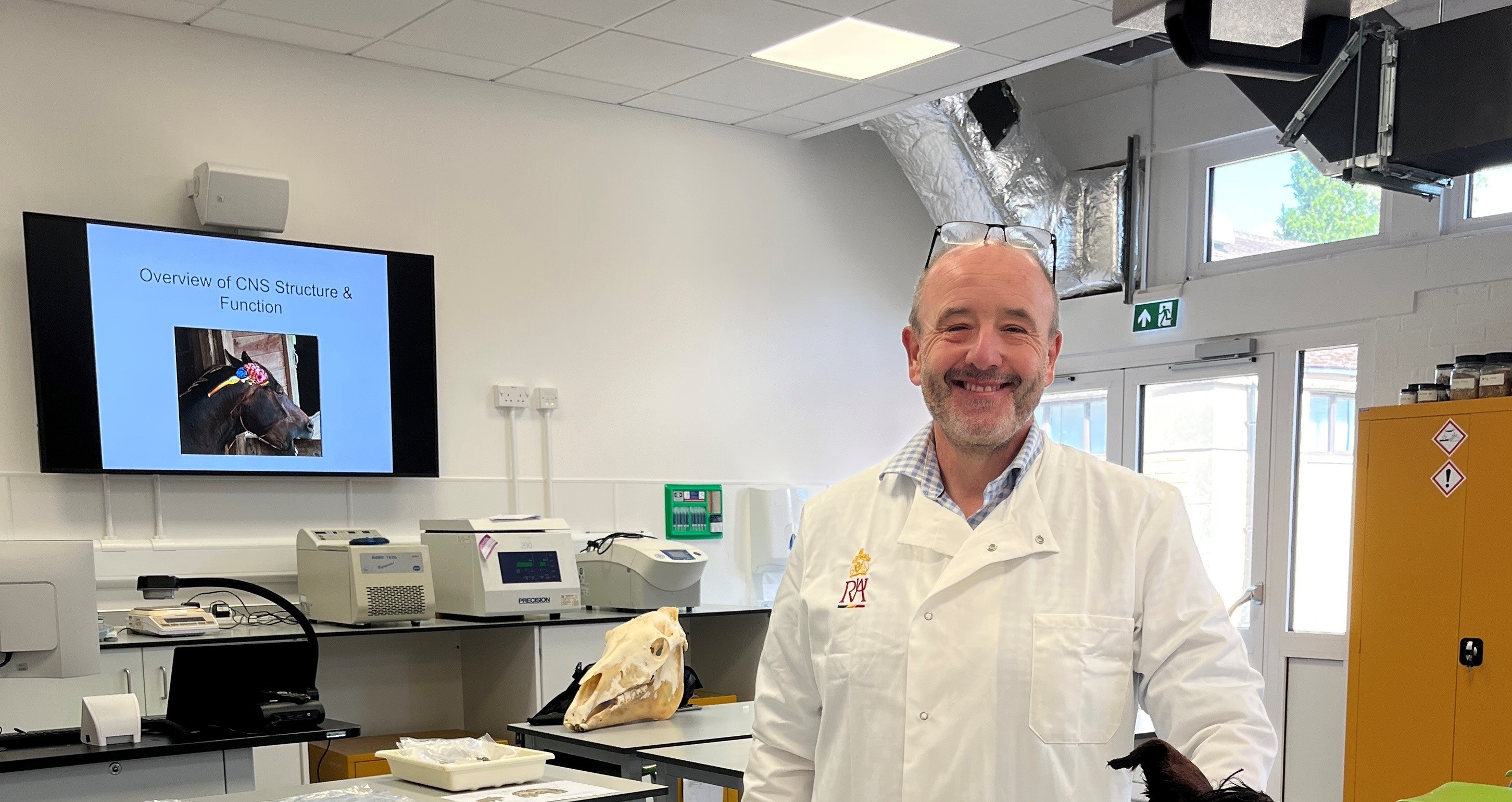
The dissection, which is part of a series of free public lectures, will highlight similarities between the horse and human brain and show how examination of certain traits in horses could help promote horse welfare while, at the same time, supporting our own mental health.
Led by Dr Andrew Hemmings, Associate Professor in Equine Research Leadership and Equine Behavioural Neuroscience at the RAU in Cirencester, the dissection will take place in the University’s new state-of-the-art laboratories.
Dr Hemmings said: “A particular part of the brain – known as the striatum – which is involved in abnormal behaviours in horses is also linked to a variety of conditions in humans that also involve abnormal behaviours, such as Schizophrenia and Autism.
“Furthermore, the anatomy of the horse striatum is remarkably similar to the same area in humans. Therefore, there is potential for research into the horse brain to teach us about human mental health too.
“Research has shown that abnormal repetitive behaviours in horses, such as crib-biting, could activate the brain’s pleasure centres in the same way as rewarding items, such as chocolate or alcohol, do in the human brain. Likewise, in the same way that humans use these commodities to help cope with stress, horses are likely to use repetitive behaviours in a stress relieving fashion.”
Dr Hemmings believes that the common practice of physically preventing repetitive behaviour with harsh devices could inhibit this coping effect, leaving horses vulnerable to the damaging effects of stress.
He explained: “In the equine world, crib-biting is still seen as a vice and can reduce the value of a horse by as much as 30% as owners and riders perceive these behaviours as undesirable and it’s generally believed that crib-biters perform worse than horses that don’t.
“However, we have found that crib-biting horses learn differently to – and learn simple tasks faster than - those who don’t, in a similar way in which neuro-diverse humans can outperform others in many spheres.”
Dr Hemmings has been a lecturer and researcher at the RAU for 27 years. He is passionate about communicating his findings to students and end-users of the research, in this case the horse owner, so that his research can impact positively on the welfare of horses in our care.
He said: “Behaviour in horses is really important as, unlike most other livestock, the ways in which we use a horse depend a lot on the animal’s behaviour. In order to understand their behaviour and temperament, we need to look closely at the organ that controls it – the brain.
“I am really excited to be bringing my dissection work into the public domain and I am convinced that there is huge potential for research into the equine brain to inform both welfare-friendly horse keeping and future studies into human mental health.
“I hope that, as well as helping attendees to understand much more about the horse and how the brain controls a horse’s behaviour, this session will also generate discussion about what the study of horse behaviour and the horse’s brain can tell us about the human equivalent.”
The free public dissection, Inside the Horse’s Mind, is part of a second annual series of free public lectures at the Cirencester-based university. The first series took place last year to celebrate the 180th anniversary of the institution which was founded in 1845 as the first agricultural college in the English-speaking world.
The dissection will take place in the University’s Land Laboratory Teaching Centre, in the Frank Garner building at the RAU’s Cirencester campus, on Wednesday 20 May 2026. Doors will open at 6pm with refreshments – free tea and coffee and a pay bar – available before the dissection starts promptly at 6.30pm.
For more information, and to book your free ticket(s), please visit https://RAUlecture-insidethehorsesmind.eventbrite.co.uk. There is plenty of free parking, and allocated disabled parking spaces, in the University’s Stroud Road car park (GL7 6JS).
“At the RAU, we have been developing entrepreneurs, innovators, and leaders, in agriculture and the land-based sector, ever since our founding in 1845. We are now seeking to help address this ongoing global emergency through a new generation of graduates and in our capacity as the leading specialist university for research in England.
“We are immensely proud of how our applied research has made a practical difference on the ground. The real key however, to unlocking the potential of innovation in agriculture and the land-based sector, is effective collaboration, communication, and dissemination of best practice. Our 2026 public Professorial Lecture series seeks to do just that.”