
UK researchers look for feedback from across the globe to find the best way to treat “kissing spines” in horses
18 August 2026
A new global study which will follow horses through their rehabilitation from a painful back condition could help researchers to further understand the condition and thereby equip owners with guidance on the best treatments.
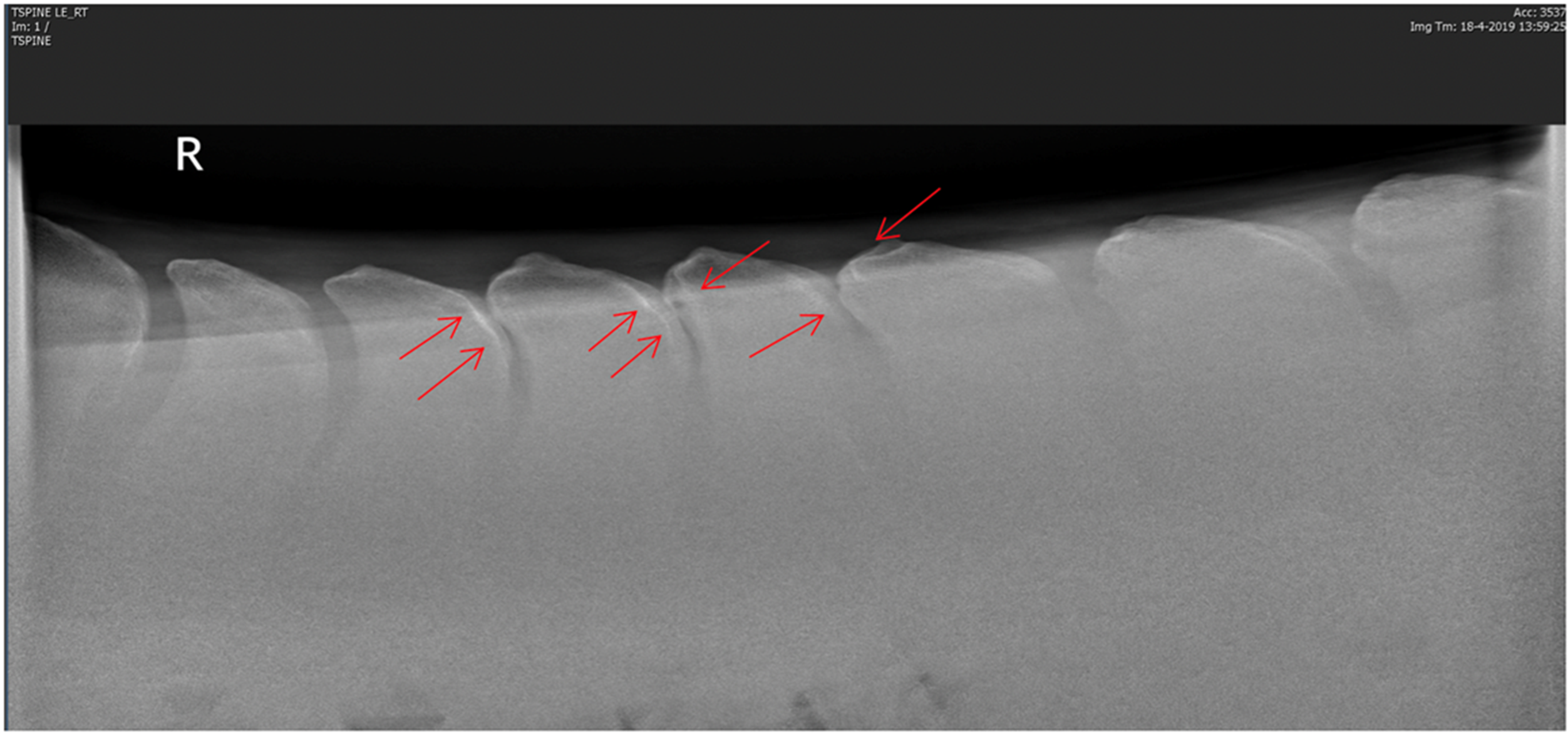
Impinging dorsal spinous processes, more commonly known as kissing spines, is a condition where the bony protrusions on a horse’s vertebrae get closer together and start touching, similar to Baastrup’s syndrome seen in humans.
Having already carried out research in the UK that highlighted the benefits of using an exercise rehabilitation programme, an equine research team at the Royal Agricultural University (RAU) aims to follow horses from across the globe through their rehabilitation in real time.
And for this, the team is looking for owners of horses that have been diagnosed with kissing spines and/or thoracic facet joint arthritis within the last two months.
Principal investigator Tracy Bye, Senior Lecturer in Equine Science at the RAU, said: “The effects of kissing spines can range from mild, localised, inflammation through to changes to the bone itself. Understandably this can be painful for the horse and can affect both its ridden career and long-term quality of life.
“Last year we published a study looking at the outcomes for 260 horses in the UK that had been diagnosed with kissing spines and one of the most striking findings was that horses whose owners implemented an exercise rehabilitation programme with them were significantly more likely to have a successful outcome, regardless of what other treatments they used.
“This has the potential to be really helpful information. If we can equip owners with the knowledge and support to rehabilitate their horses, we could greatly improve the outcomes and quality of life for horses diagnosed with this condition, for little to no additional cost to the owner.”
In order to provide the best advice, the team working on this research needs to get more information on rehabilitation practices used for kissing spines, and other back conditions, and their relative success rate, as well as data on the experiences of owners rehabilitating these horses to help determine how best to support them.
The team’s new global study will follow horses through their rehabilitation in real time and, to do this, they want to hear from owners, with horses affected by kissing spines, worldwide.
The study is being led by RAU postgraduate student Becky Brassington who is studying for a MSc by Research in Equine Science. Becky, who is also Director of Higher Education at University Centre Bishop Burton in East Yorkshire, explained: “As well as research here in the UK, we know that research into kissing spines and other back conditions has previously been conducted in Europe, the USA and Australia.
“For this study, we are inviting owners from any country, whose horses have been diagnosed with kissing spines and/or thoracic facet joint arthritis within the last two months, to take part.
“By extending our research globally, we aim to gather a broad and wide-ranging data set which captures the experiences of horses and their owners around the world.”
Owners will be asked to complete an initial survey to give details of the initial diagnosis and treatment of the condition. They will then be sent a follow up survey - at both three- and six-months post diagnosis - to see how the horse is doing.
To get a complete picture of the horse’s treatment, the RAU researchers also hope to be able to speak to the vet treating each horse as well as any therapists the owners are using to help with the rehabilitation.
Tracy added: “We know that it can be stressful for owners when their horse has just been diagnosed with a condition like this, and taking part in research might be the furthest thing from their mind.
“But, in order to get the most accurate data, it’s really important that we gather information as soon as possible after the horse is diagnosed and the treatment plan developed, so that all of the details are fresh in the owner’s mind.
“The aim is that the data provided here will inform rehabilitation recommendations for horses diagnosed with back conditions in the future which could help hundreds of horses have a better chance of recovery.”
Owners who are interested in taking part in this project can sign up at https://app.onlinesurveys.jisc.ac.uk/s/rau/owner-consent. For more information, and for any questions about the study and taking part, please contact Becky at rebecca.brassington@student.rau.ac.uk.
All the data collection will be completed digitally and managed in accordance with the EU General Data Protection Regulation.
Brassington, R., Hardy, R., & Bye, T. (2025). Long‐term effects of treatment and management approaches for impinging dorsal spinous processes in ridden horses. Equine Veterinary Education, 37(7), 382-388. https://beva.onlinelibrary.wiley.com/doi/full/10.1111/eve.14057