
University archaeologists uncover ancient Celtic sacred site in the Cotswolds
2 June 2026
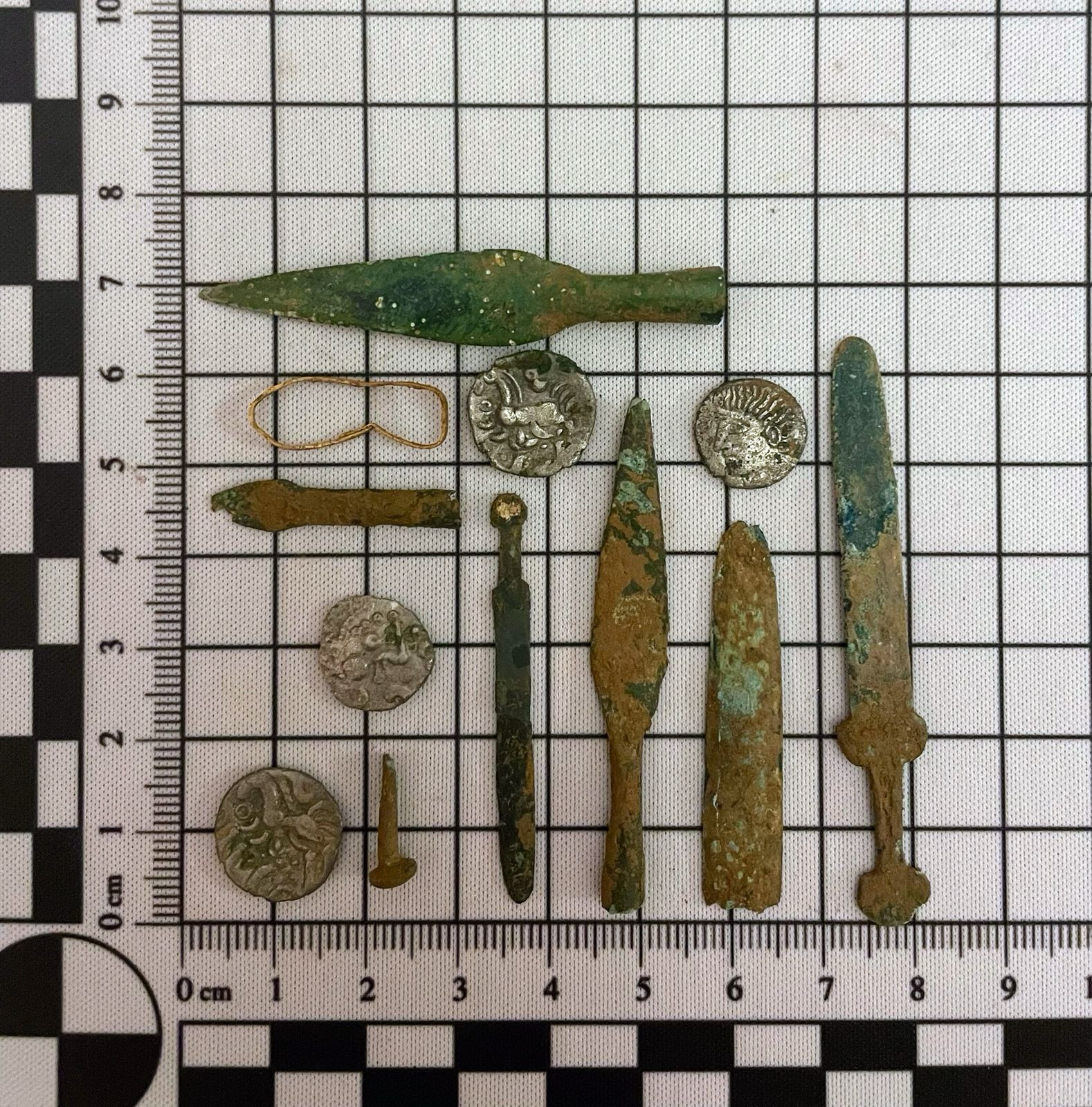
Archaeologists working near Cirencester in the Cotswolds have discovered coins and iron spear heads, as well as miniature bronze shields and spearheads, at a major ‘votive’ site dating back to the late Iron Age (c.100BC- 43AD).
The site was first discovered by a metal detectorist in 2020 when a hoard of more than 150 silver and bronze coins and metalwork, which has now been acquired by the Corinium Museum in Cirencester, was uncovered.
This further archaeological work, conducted by the Royal Agricultural University (RAU) as part of a training excavation for the university’s MSc students, has now revealed the scale and national importance of the site. Working with the original finder, and in collaboration with the land owner, archaeologists were able to relocate the original hoard pit and place it in its historic context.
Professor Mark Horton, the RAU’s Pro Vice-Chancellor for Research who is also Director of the University’s Cultural Heritage Institute which offers MSc programmes in Archaeology, Cultural Heritage, and Historic Building Conservation, ran the excavations.
He explained: “Our archaeologists found that the hoard had been inserted into a sacred precinct marked out by a large area of cobbled pavement. These stones were worn flat by extensive wear which suggests that some form of mass processional activity took place around the central area of the sacred site.
“During our excavations we also discovered multiple spears which had been inserted - often vertically - into the soil to ‘protect’ this central area. Some were iron but others were miniature spears, sometimes less than an inch in length, made of bronze.
“Model swords and scabbards, daggers, and shields, also made of bronze, were found scattered around this central deposit. These would have been used as ritual offerings, known as ‘votives’, and many of these had been deliberately broken into pieces, to signify that they were offerings to the gods and were not to be recovered and reused.”
The site rested over a series of small pits cut into the local Cotswold limestone and filled with a fine soil which the archaeologists believe had been introduced to the site. These pits were completely empty of any artefacts and the researchers think these holes may have been deliberately cut into the bedrock to plant trees or bushes.
Professor Horton added: “This is a major find. We know so little about Iron Age or Celtic religion beyond the literary sources, written by the classical authors. Here we have direct archaeological evidence of religious practices at the very end of the Iron Age, on the eve of the Roman invasion.
“The many coins found show that the site belonged to the Dobunni tribe whose capital was at Bagendon, just a few miles away from our dig site. Our newly discovered site was likely a natural place, or possibly a grove of trees, where offerings were made to the Celtic gods.”
Many of the coins from the hoard feature a distinctive three-tailed horse motif which is believed to be typical of the Dobunni tribe.
The original hoard of coins, which was officially been declared Treasure under the Treasure Act, has now been secured by Cirencester’s Corinium Museum which raised £13,250 for its acquisition.
The Museum now needs to raise £25,000 for the objects’ conservation and display and a fundraising campaign is being led by the Friends of Corinium Museum, with the aim of getting the hoard on display to the public sometime next year.
The excavation site has now been refilled to protect the site but Professor Horton hopes that the RAU will be able to undertake another excavation next year.
For more photographs of the finds from the dig, please click here.
Notes: The Dobunni tribe lived in Gloucestershire, North Somerset, southern Worcestershire, and western Oxfordshire. They were mostly mixed farmers, exploiting the rich lands of the Severn Vale. Their coinage was likely issued by tribal leaders, c. 50 BC- 20 AD of whom Bodvic (c. 25-5 BC) issued the largest number of silver coins and is represented in the hoard find.
The Dobunni, well known for their active collaboration with the Roman invaders, were rapidly Romanised and may have been some of the earliest builders of countryside villas in Britain. After the Roman conquest, the Dobunni capital was relocated to Cirencester, or Corinium Dobunnorum, and Bagendon and their sacred sites were likely abandoned.