
University’s proposed Innovation Village gains outline planning consent
13 May 2026
The UK’s first Innovation Village for the land-based sector moved a step closer today when planning committee councillors voted unanimously to grant outline planning permission.
Centred on agriculture, food, and land management, the Royal Agricultural University’s (RAU) Innovation Village will act as a hub for research, collaboration, and practical solutions in the sector, combining the RAU’s specialist expertise with international partnerships to drive economic growth, sustainability, and educational excellence, shaping the future of sustainable innovation.
Professor Peter McCaffery, Vice-Chancellor of the RAU, said: “We are delighted that our application for outline planning has been approved. The RAU celebrated its 180th anniversary last year and today’s endorsement by Cotswold District Council’s Planning Committee marks another significant milestone in the evolution of our University.
“The Innovation Village will be a major centre, both in the UK and internationally, for agriculture related innovation, and is integral to the RAU as well as being a UK first. Our researchers will join with industry, food producers, farmers, and landowners in developing sustainable solutions to food production and biodiversity recovery while building resilience in rural communities.
“It will encourage 16-to-24-year-olds to stay within Gloucestershire by providing skills training and employment opportunities, and will be a beacon for UK and international businesses and our university partners.
“Committed to regenerative agriculture, it will enhance the UK’s international standing, driving economic growth through applied research, developing a highly skilled workforce to build national capabilities within this priority sector.”
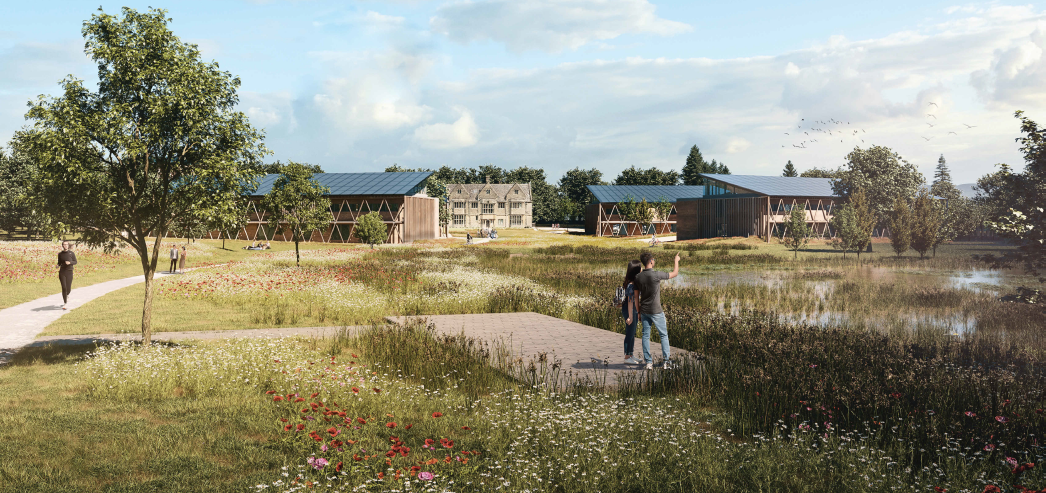
The Innovation Village - on a 12-hectare University-owned site next to its main Cirencester campus – will be a 24,000 sqm multi-use development of laboratories, office space, and event and hospitality facilities.
It will be carbon neutral, rich in nature, and will inspire innovation through its environment. Its buildings will achieve the Passivhaus Plus standard, radically reducing energy use while also creating comfortable, healthy environments for occupants.
Demonstrating new innovations in sustainability, energy usage, build quality, materials, and landscaping, it will be a truly net-zero and exemplary sustainable development, the likes of which do not currently exist anywhere else.
Cllr Tristan Wilkinson, Cotswold District Council Cabinet Member for Economy and Council Transformation, said: “This is a truly exciting announcement. The Innovation Village reflects the direction set out in our corporate priorities for a more diverse, resilient, and sustainable local economy.
“It has the potential to support green growth and agri‑tech innovation, attract high-value, low-carbon businesses, and create skilled jobs that strengthen the Cotswolds beyond its world-renowned visitor economy. Supporting this outline application is an important step towards building long‑term opportunities and leaving a strong legacy.”
Cllr Julian Tooke, Cabinet member for Business, Economic Development, Planning and Infrastructure at Gloucestershire County Council, said: “This is a significant step forward for Gloucestershire and a clear vote of confidence in our county as a centre for innovation in agriculture, food and land management.
“The Innovation Village will help create high-quality skills and employment opportunities, particularly for our young people, while supporting sustainable growth in our rural economy.
“It builds Gloucestershire’s strong partnerships between education, industry and the public sector, and will play an important role in shaping a more resilient, low-carbon future. Great news for the county.”
The RAU currently contributes more than £50m a year to the local economy in Gloucestershire and, when fully-fledged, it is estimated that the Innovation Village will generate an additional £50m a year.
Professor McCaffery added: “Our international partners will also play an active part in the ecosystem of organisations that we are helping to convene at our Cirencester campus - alongside SMEs, industry R&D, government agencies, charities, community bodies, and other UK universities.
“Since launching the proposal, we have been in contact with many potential investors and funders and, following today’s decision, we are now in a position to move forward with those discussions.
“Today is an exciting day, not only for us at the RAU but also for the town of Cirencester and for Gloucestershire as a whole.”