
A Practice-based Researcher’s Perspective on the Reversing the Gaze workshop
by Dr Michael Bowdidge, June 2026
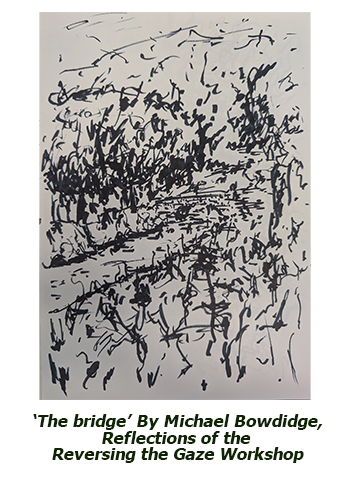 Taking part in the Reversing The Gaze workshop (1-2 September, 2025) as a visual artist and independent practice-based researcher (and also being offered the opportunity to open the first session with a practice-based warm-up activity) was a novel and positive experience for me, and one that has led me to a number of useful insights. I’d like to take this opportunity to unpack them briefly.
For me, the most important of those was as follows: participating in the workshop helped me to finally fully embrace a tentative notion that I had been entertaining for a while. This could be usefully summarised as having a clear sense that the interests and concerns of my practice-led research were broadly in alignment with those of the contemporary Scottish community land reform movement.
I want to be absolutely clear that the previous statement is not intended in any way to homogenise or flatten the vital differences in perspective and experience that exist within that community. Rather, what I am trying to get at here is more akin to having found an unexpected place within that community, or as Wittgenstein would put it, a sudden recognition of an unexpected ‘family resemblance’.
This may, from the outside, perhaps seem like a less than stellar insight, however as an independent practice-based/led arts researcher, one often has the sense that one is following one’s nose in a somewhat intuitive way which tends not to always bring one to recognised destinations. So for me, the sense of having arrived somewhere quite specific and recognisable in this instance is perhaps a little more shocking to me than might be expected.
To provide a little more context to here: my work as a practice-based independent researcher currently takes the form of informal (and ‘unlicensed’) temporary sculptural interventions in a specific rural landscape (a historic designed landscape in Killearn, Stirlingshire).
Without getting into the details of my research at length, what this process has led me to, in general terms, is a recognition that (for me, at least) the most useful insights usually emerge from the consideration of the specifics of a given setting or situation in depth, particularly in relation to matters of land use/ownership and the possibility of thinking about these subjects otherwise.
It was therefore also really heartening to see a similar process at work during the group discussions which took place on the afternoon of the first day of the workshop. Listening and holding space for different perspectives and lived experiences in these sessions invariably led us to the best and most useful insights and revealed once again the real value of this workshop had as a space for these conversations to take place.
The final thing I want to add here takes the form of a note of thanks to the event organisers. I can’t be alone in having gained a renewed sense of purpose from taking part in this workshop. Doing so has given me a much-needed boost in relation to my research, a deeper understanding of the context and utility of my sculptural re-commoning practice, a much better sense of the broader context of the Scottish bland reform community and an awareness of the importance of ensuring that it continues to be constituted by as broad a range of voices and perspectives as possible.